
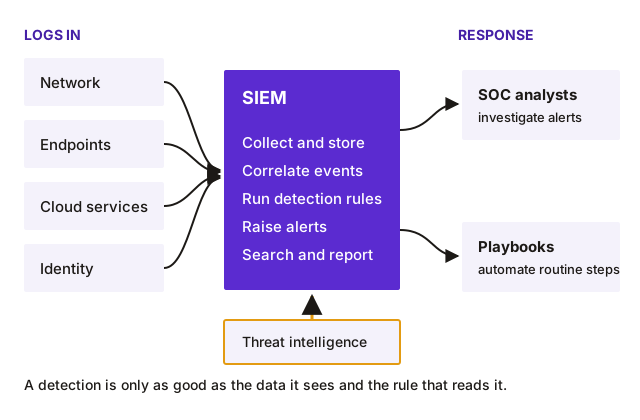
A SIEM, short for security information and event management, is the system a security operations team watches all day. It collects logs from across the organisation, stores them, connects related events and runs detection rules that raise alerts when something looks like an attack. It is also where analysts search during an investigation and where most compliance reports come from.
Almost every organisation with a security operations centre runs one. The questions now are which kind to run and how much data to send it.
What the numbers say
Teams still believe in the SIEM. In Sumo Logic's 2025 security operations survey, nine in ten respondents said the SIEM approach is still relevant for protecting their organisation. Many are unhappy with the one they have. In the same survey 73% of security leaders said they were reassessing their SIEM, half reported difficulty fitting a legacy SIEM into the rest of their technology, and 75% of those confident in their current SIEM were still looking at alternatives.
Results are mixed. In Sumo Logic's January 2026 report, 52% of security operations leaders were very confident their SIEM could scale to future needs, and 51% said it was very effective at cutting the time to detect and respond to threats. The CardinalOps 2025 State of SIEM report found that SIEMs collect enough telemetry to detect more than 90% of MITRE ATT&CK techniques, yet miss 79% of the techniques adversaries use, because detection rules are still written and tuned by hand.
Most of these surveys come from SIEM vendors, so treat them as a picture of buyer mood.
What a SIEM does
Collection and storage come first. The SIEM receives logs from firewalls, endpoints, cloud services, identity providers and business applications, and keeps them for search and for compliance.
Correlation connects events that mean little alone. A login from a new device followed by a large download from the same account can add up to one alert.
Detection rules turn that data into alerts. Most SIEMs ship with a library of rules mapped to MITRE ATT&CK, and teams add their own.
Investigation happens in the same place. Analysts search the stored logs to work out what happened and how far it went.
Response is increasingly built in. Many SIEMs now include SOAR, security orchestration, automation and response, which runs playbooks for routine steps such as blocking an address or disabling an account.
How the market is changing
The SIEM is moving to the cloud. Most new deployments are software as a service, priced by the volume of data taken in, which is why so many teams now put a security data pipeline in front of the SIEM to send it less.
The SIEM is also becoming part of larger platforms. Endpoint and network security vendors now sell their own SIEM alongside their other products, and some bought their way in. Palo Alto Networks took over IBM's QRadar SaaS business in September 2024 and offered QRadar customers a move to its own platform.
AI is now a buying criterion. In Sumo Logic's 2025 survey, 90% of security leaders called AI a key driver when choosing a SIEM or an alternative, and 70% said AI shapes their trust in current and future SIEM products. 34% of respondents said AI playbooks had cut their average incident response time. Teams also want the SIEM to watch AI itself. In Exabeam's September 2026 research, 56% of security leaders said they extend their existing SIEM, detection or monitoring tools to monitor AI agents.
What to check before you buy
Start with data cost. Ask for a price at your real daily log volume and at the volume you expect in two years, and find out what happens to the bill if a new source doubles it.
Check detection content. Ask how many detection rules come with the product, how they map to MITRE ATT&CK and who keeps them up to date. Then test them against your own data.
Look at integrations. In Sumo Logic's 2025 survey, 85% of security teams called built-in threat intelligence essential and 84% rated built-in SOAR as important or extremely important.
Think about leaving before you join. Of those weighing new options in the same survey, 95% named flexibility as critical. Find out whether you can export your data and rules in an open format, and whether the product accepts data from a pipeline you control.
Run a proof of concept on your own logs. A few weeks with your two noisiest sources shows the real data volume and the alerts you would get.
Who sells SIEM
The market has two groups. Specialists sell the SIEM as their main product. Larger security and technology companies sell a SIEM as part of a wider platform.
Companies focused on SIEM
14 companies| Company | Based in | Founded | Size | Ownership | Revenue |
|---|---|---|---|---|---|
 Elastic Elastic provides the Elasticsearch Platform, which includes search, observability, and security solutions. | Mountain View, United States | 2012 | Public, ESTC | $1.7bn (FY2026) | |
 IBM IBM is a technology company that sells software, infrastructure, and consulting services. | Armonk, United States | 1911 | 352,600 staff | Public, IBM | |
 Abstract Security Abstract provides a composable SIEM platform for security operations. | United States | 2023 | Private | ||
 Artemis Security Artemis Security provides an AI-native security operations platform that detects, investigates and responds to cyber attacks. | New York, United States | Private | |||
 Blumira Blumira provides a security operations platform for IT teams to detect and respond to threats. | Ann Arbor, United States | Private | |||
 Cylake Cylake provides an AI-native cybersecurity platform for air-gapped sovereign environments. | Sunnyvale, United States | 2026 | Private | ||
 Exabeam Exabeam provides security operations platforms that use behavioural analytics to detect and respond to threats. | Broomfield, United States | 2013 | Owned by Thoma Bravo | ||
 LogPulse LogPulse provides log management and security monitoring hosted in the EU. | Netherlands | 2026 | Private | ||
 Securonix Securonix provides a cloud-native platform for security operations, combining SIEM, UEBA, SOAR and threat intelligence. | San Mateo, United States | 2008 | Private | ||
 Sekoia Sekoia provides an AI-driven security operations platform for detecting, investigating and responding to cyber threats. | Rennes, France | 2022 | Private | ||
 Splunk Splunk provides a data platform for security, observability, and AI. | San Jose, United States | 2004 | Owned by Cisco | ||
 Stellar Cyber Stellar Cyber provides an AI-native security operations platform that unifies detection and response tools. | San Jose, United States | 2015 | Private | ||
 Sumo Logic Sumo Logic provides cloud log management, monitoring, and SIEM tools for security and operations teams. | Redwood City, United States | 2010 | Owned by Francisco Partners | ||
 Wazuh Wazuh provides an open source platform for security monitoring and threat detection. | San Jose, United States | 2015 | Private |
Also active in SIEM
23 companies| Company | Based in | Founded | Size | Ownership | Revenue |
|---|---|---|---|---|---|
 Microsoft Microsoft sells software, cloud services, hardware, and gaming products. | Redmond, United States | 1975 | 228,000 staff | Public, MSFT | $331.8bn (FY2026) |
 Palo Alto Networks Palo Alto Networks provides cybersecurity platforms and services to protect organizations from cyber threats. | Santa Clara, United States | 2005 | 13,900 staff | Public, PANW | $11.5bn (FY2026) |
 Fortinet Fortinet provides cybersecurity solutions and services, including networking and security convergence, for enterprises and governments. | Sunnyvale, United States | 2000 | 15,109 staff | Public, FTNT | $6.8bn (FY2025) |
 CrowdStrike CrowdStrike provides AI-native cybersecurity solutions to stop breaches. | Austin, United States | 2011 | 7,925 staff | Public, CRWD | $4.8bn (FY2026) |
 Rapid7 Rapid7 provides AI-powered managed cybersecurity operations, including MDR, SIEM, and vulnerability management. | Boston, United States | 2000 | 500+ staff | Public, RPD | $859.8m (FY2025) |
 Google World-renowned cybersecurity firm now part of Google Cloud, delivering threat intelligence-led penetration testing and red teaming informed by front-line incident response experience. | Mountain View, United States | 2004 | 500+ staff | Private | |
 7AI 7AI provides AI agents that automate security operations centre tasks for enterprises. | Boston, United States | 2024 | Private | ||
 Anomali Anomali provides a threat intelligence platform and security analytics, built around its ThreatStream intelligence management product. | United States | 2013 | Private | ||
 Binary Defense Binary Defense provides managed detection and response services and an AI-powered security platform. | Stow, United States | Private | |||
 Cribl Cribl provides a vendor-agnostic platform for managing, investigating, and analyzing telemetry data. | San Francisco, United States | 2018 | Private | ||
 CybaVerse CybaVerse provides a unified cyber security operations platform called CybaOps. | Portsmouth, United Kingdom | 2018 | Private | ||
 D3 Security D3 Security provides an agentic SOC platform that autonomously triages, investigates, and responds to security alerts. | Vancouver, Canada | 2002 | Private | ||
 Edge Delta Telemetry pipelines that route, enrich and transform security and observability data to SIEMs and other destinations, plus AI agents for site reliability work. | Seattle, United States | Private | |||
 Exaforce Exaforce provides an agentic AI platform for security operations, detection, triage, investigation and response. | San Jose, United States | 2023 | Private | ||
 Foresite Cybersecurity Foresite provides managed detection and response services using agentic AI for security operations. | Overland Park, United States | Private | |||
 Huntress Huntress provides managed cybersecurity services including endpoint detection, identity threat detection, and security awareness training. | Columbia, United States | Private | |||
 Intezer Intezer provides an AI-powered security operations center that investigates all alerts at forensic depth. | New York, United States | 2015 | Private | ||
 ManageEngine ManageEngine provides IT operations, cybersecurity, and service management software for businesses. | Chennai, India | 1996 | Private | ||
 Mezmo Mezmo sells an open-source agent harness called AURA, which runs in a customer's own environment using their tools, telemetry and operational context. | San Jose, United States | 2015 | Private | ||
 NetWitness NetWitness provides cybersecurity platforms for threat detection, investigation and response across IT and OT environments. | Riverside, United States | 1997 | Private | ||
 Qevlar AI Qevlar AI provides an autonomous security operations platform that investigates alerts and automates response. | Paris, France | 2023 | Private | ||
 Swimlane Swimlane provides agentic AI automation for security operations, vulnerability management, and compliance. | Denver, United States | 2015 | Private | ||
 Bindplane OpenTelemetry pipeline that collects, reduces, masks and routes logs and other telemetry to SIEM, storage and observability tools. | United States | Private |
Who owns them
Ownership changed hands at the top of the market. Cisco agreed to buy Splunk for about $28 billion in September 2023. Francisco Partners took Sumo Logic private for about $1.7 billion in 2023. In 2024 Thoma Bravo merged LogRhythm with Exabeam, and Palo Alto Networks bought IBM's QRadar SaaS business. In June 2025 Securonix bought ThreatQuotient, a threat intelligence company.
For buyers this means fewer independent choices and more SIEMs tied to a wider platform. It is worth asking each vendor how its roadmap depends on its owner.
Who funds them
New entrants are still raising money. Cylake raised a $45 million seed round in March 2026 and $245 million more in September 2026, before releasing its product. Abstract Security raised $25 million in July 2026.
Recent deals
| Date | Deal | Amount | Source |
|---|---|---|---|
| September 2026 | Cylake raised a convertible noteCylake provides an AI-native cybersecurity platform for air-gapped sovereign environments.Investors Lightspeed Venture Partners, Picture Capital and Redpoint | $245m | Report on the Cylake funding round of September 2026 (opens in a new tab)via Security, Funded (opens in a new tab) |
| July 2026 | Abstract Security raised fundingAbstract provides a composable SIEM platform for security operations.Investors AVP and Cheyenne Ventures | $25m | Report on the Abstract Security funding round of July 2026 (opens in a new tab)via Security, Funded (opens in a new tab) |
| April 2026 | Artemis Security raised a seed roundArtemis Security provides an AI-native security operations platform that detects, investigates and responds to cyber attacks.Investors Brightmind Partners and First Round Capital | $15m | Report on the Artemis Security funding round of April 2026 (opens in a new tab)via Security, Funded (opens in a new tab) |
| March 2026 | Cylake raised a seed roundCylake provides an AI-native cybersecurity platform for air-gapped sovereign environments.Investor Greylock | $45m | Report on the Cylake funding round of March 2026 (opens in a new tab)via Security, Funded (opens in a new tab) |
| June 2025 | Securonix acquired ThreatQuotientProvides a threat intelligence platform | Undisclosed | Report on Securonix buying ThreatQuotient, June 2025 (opens in a new tab)via SecurityWeek (opens in a new tab) |
| October 2024 | Abstract Security raised a Series A roundAbstract provides a composable SIEM platform for security operations.Investor Munich Re Ventures | $15m | Report on the Abstract Security funding round of October 2024 (opens in a new tab)via Security, Funded (opens in a new tab) |
| May 2024 | LogRhythm acquired ExabeamExabeam provides security operations platforms that use behavioural analytics to detect and respond to threats. | Undisclosed | Report on LogRhythm buying Exabeam, May 2024 (opens in a new tab)via SecurityWeek (opens in a new tab) |
| March 2024 | Abstract Security raised a seed roundAbstract provides a composable SIEM platform for security operations.Investors Crosslink Capital, Rally Ventures and Liquid 2 Ventures | $8.5m | Report on the Abstract Security funding round of March 2024 (opens in a new tab)via Security, Funded (opens in a new tab) |
| September 2023 | Cisco acquired SplunkSplunk provides a data platform for security, observability, and AI. | $28bn | Report on Cisco buying Splunk, September 2023 (opens in a new tab)via SecurityWeek (opens in a new tab) |
| August 2023 | Stellar Cyber raised fundingStellar Cyber provides an AI-native security operations platform that unifies detection and response tools. | $20.5m | Report on the Stellar Cyber funding round of August 2023 (opens in a new tab)via Security, Funded (opens in a new tab) |
| June 2023 | Blumira raised a Series B roundBlumira provides a security operations platform for IT teams to detect and respond to threats.Investor Ten Eleven Ventures | $15m | Report on the Blumira funding round of June 2023 (opens in a new tab)via Security, Funded (opens in a new tab) |
| February 2023 | Francisco Partners acquired Sumo LogicSumo Logic provides cloud log management, monitoring, and SIEM tools for security and operations teams. | $1.7bn | Report on Francisco Partners buying Sumo Logic, February 2023 (opens in a new tab)via SecurityWeek (opens in a new tab) |