
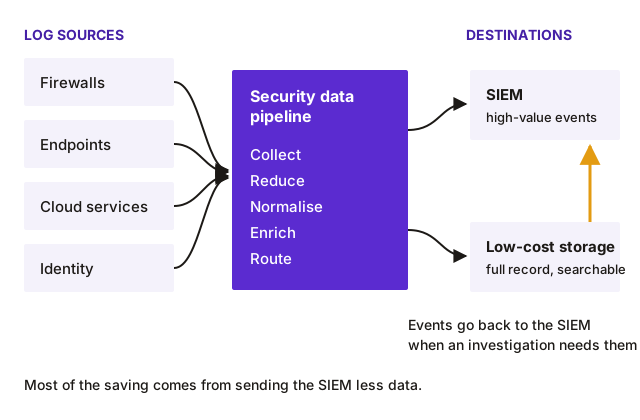
A security data pipeline sits between the systems that produce security logs and the tools that use them. It collects events from firewalls, endpoints, cloud services and identity providers, then filters, reshapes, enriches and routes them before they reach a SIEM or a data lake.
Teams usually buy one for cost. Most SIEMs charge by the volume of data they take in, and much of that volume is repeated or low value. A pipeline lets a team send the SIEM only the events it uses for detection, and keep the rest somewhere cheaper but still searchable.
What the numbers say
The SIEM is rarely short of data. The CardinalOps 2025 State of SIEM report found that SIEMs take in an average of 259 log types from nearly 24,000 log sources, enough telemetry to detect more than 90% of MITRE ATT&CK techniques. Yet they miss 79% of the techniques adversaries use, because detection rules are still written and tuned by hand.
Managing that data is also a skills problem. In Red Canary's 2025 Security Operations Trends Report, 70% of in-house SOC teams reported a shortage of SIEM data management skills, and 54% of organisations already used AI for SIEM data management.
Many teams are looking at alternatives. In Sumo Logic's 2025 security operations survey, 73% of security leaders said they were reassessing their SIEM, and 95% of those weighing new options named flexibility as critical. Its January 2026 report found that 90% of security operations leaders rate support for multi-cloud and hybrid-cloud data sources as very or extremely important for their SIEM.
What a security data pipeline does
Collection comes first. The pipeline receives logs from agents, syslog, cloud APIs and message queues, so each source only has to be connected once.
Reduction is the step most buyers care about. The pipeline drops duplicate events and fields that no detection rule reads. It also summarises noisy sources such as firewall and DNS logs. The aim is to cut volume without cutting what the security team needs to see.
Normalisation turns each vendor's log format into one schema, so a detection rule works whatever the source. Many products now support OCSF, the Open Cybersecurity Schema Framework, an open schema started in 2022 that moved to the Linux Foundation in November 2024.
Enrichment adds context on the way through, such as the user behind an IP address or a threat intelligence match.
Routing sends each event to the right place. High-value events go to the SIEM and the full record goes to low-cost storage. Good pipelines keep the stored data searchable and can send events back to the SIEM later when an investigation needs them.
What to check before you buy
Start with your own sources and destinations. Ask each vendor to show the connectors for your top ten log sources and for your SIEM, and check whether they are built and maintained by the vendor or left to you.
Ask how the product decides what to drop. Reduction that ignores your detection rules can save money and quietly create blind spots. The useful test is detection coverage before and after, measured on your own data.
Check where the data goes when it leaves the SIEM. Storage is only cheap if you can still search it, and only useful if you can get events back into the SIEM quickly when you need them.
Look at schema support. If you plan to change SIEM or run more than one, a pipeline that normalises to an open schema such as OCSF makes the move easier.
Find out who will run it. That depends on the product. Some are built for data engineers and expose every setting, others are built for security operations teams and handle the tuning for them.
Ask about deployment and pricing. Some products run as a cloud service and some inside your own environment. Most charge by data volume, so compare prices at your real daily volume, not a sample.
Run a trial on real data. A short test on one heavy source, usually firewall logs, over about a week shows the volume saved and any effect on detection coverage before you commit.
Who sells security data pipelines
The vendors fall into two groups. Specialists sell the pipeline as their main product. Larger security and data companies sell a pipeline as part of a SIEM or an observability suite.
Featured
Featured listings are promoted placements, shown here and labelled.
| Company | Based in | Founded | Size | Ownership | Revenue |
|---|---|---|---|---|---|
 FeaturedRealm.Security Realm Security provides a SOC-aware security data pipeline that reduces SIEM log volume without breaking threat detections. | Boston, United States | 2024 | Private |
Companies focused on security data pipelines
12 companies| Company | Based in | Founded | Size | Ownership | Revenue |
|---|---|---|---|---|---|
 Axoflow Axoflow provides an autonomous security data layer that curates and manages security data for SecOps. | Budapest, Hungary | 2023 | Private | ||
 Cribl Cribl provides a vendor-agnostic platform for managing, investigating, and analyzing telemetry data. | San Francisco, United States | 2018 | Private | ||
 DataBahn DataBahn provides an agentic data control plane for managing and optimizing enterprise telemetry. | Dallas, United States | 2023 | Private | ||
 Edge Delta Telemetry pipelines that route, enrich and transform security and observability data to SIEMs and other destinations, plus AI agents for site reliability work. | Seattle, United States | Private | |||
 Gigamon Gigamon sells a deep observability pipeline that collects network traffic and turns it into telemetry for security and monitoring tools. | Santa Clara, United States | 2004 | Owned by Elliott Investment Management | ||
 Mezmo Mezmo sells an open-source agent harness called AURA, which runs in a customer's own environment using their tools, telemetry and operational context. | San Jose, United States | 2015 | Private | ||
 Sawmills Sawmills provides an agentic telemetry management platform. | San Mateo, United States | 2024 | Private | ||
 Tenzir Tenzir provides an agentic telemetry pipeline for data-driven cyber defenders. | Hamburg, Germany | 2017 | Private | ||
 VirtualMetric VirtualMetric provides a security data pipeline platform that collects, normalizes, enriches, filters, and routes data to SIEMs. | Amsterdam, Netherlands | 2016 | Private | ||
 Bindplane OpenTelemetry pipeline that collects, reduces, masks and routes logs and other telemetry to SIEM, storage and observability tools. | United States | Private | |||
O Observo AI Observo AI built an AI-native security data pipeline that filtered and enriched telemetry before it reached the SIEM. | Newark, United States | 2022 | Part of SentinelOne | ||
 Onum Onum built a real-time telemetry pipeline that filtered, enriched and routed security data in stream. | Madrid, Spain | 2022 | Part of CrowdStrike |
Also active in security data pipelines
11 companies| Company | Based in | Founded | Size | Ownership | Revenue |
|---|---|---|---|---|---|
 CrowdStrike CrowdStrike provides AI-native cybersecurity solutions to stop breaches. | Austin, United States | 2011 | 7,925 staff | Public, CRWD | $4.8bn (FY2026) |
 Elastic Elastic provides the Elasticsearch Platform, which includes search, observability, and security solutions. | Mountain View, United States | 2012 | Public, ESTC | $1.7bn (FY2026) | |
 SentinelOne SentinelOne provides an AI-native cybersecurity platform for endpoint, identity, and cloud protection. | Mountain View, United States | 2013 | Public, S | $1.0bn (FY2026) | |
 Abstract Security Abstract provides a composable SIEM platform for security operations. | United States | 2023 | Private | ||
 Censys Censys maps internet infrastructure and provides intelligence for security operations and exposure management. | Ann Arbor, United States | 2017 | Private | ||
 GitHub GitHub is a software development platform where developers, agents, and code come together. | San Francisco, United States | 2007 | Part of Microsoft | ||
 ReversingLabs ReversingLabs provides software supply chain security and threat intelligence to verify and secure enterprise software. | Cambridge, United States | Private | |||
 Splunk Splunk provides a data platform for security, observability, and AI. | San Jose, United States | 2004 | Owned by Cisco | ||
 Sumo Logic Sumo Logic provides cloud log management, monitoring, and SIEM tools for security and operations teams. | Redwood City, United States | 2010 | Owned by Francisco Partners | ||
 Axonius Asset intelligence platform that builds one inventory of every asset from connected IT and security tools to find coverage gaps and prioritise exposures. | New York, United States | Private | |||
 Cohesity Data security and backup platform with immutable backups, threat detection and ransomware recovery, protecting more than 1,000 workload types. | Santa Clara, United States | Private |
Who owns them
The market consolidated quickly in 2025. Two large security platforms bought specialists to feed their own SIEMs. CrowdStrike agreed to buy Onum for about $290 million in August 2025, and SentinelOne agreed to buy Observo AI for about $225 million in September 2025. In July 2025 Monad took over Tarsal, and in April 2026 Dynatrace agreed to buy Bindplane, the OpenTelemetry pipeline formerly called observIQ.
The best-funded independent specialist has started buying too. Cribl bought CardinalOps, a detection engineering company, in July 2026 and Radiant Security's AI SOC technology in August 2026, which takes it beyond moving security data into analysing it.
For buyers, a vendor owned by a security platform may work best with that platform's own SIEM. It is worth asking how long other destinations will stay supported.
Who funds them
Investors kept backing independent specialists. Cribl raised a $319 million Series E in August 2024. DataBahn raised a $17 million Series A in June 2025 and a $40 million Series B in July 2026. Realm Security raised a $15 million Series A in October 2025, and Axoflow raised a $7 million seed round in January 2025.
Recent deals
| Date | Deal | Amount | Source |
|---|---|---|---|
| 19 Aug 2026 | Cribl acquired Radiant Security’s AI SOC technology | Undisclosed | Report on Cribl buying Radiant Security’s AI SOC technology, 19 Aug 2026 (opens in a new tab) |
| July 2026 | DataBahn raised a Series B roundDataBahn provides an agentic data control plane for managing and optimizing enterprise telemetry.Investor Insight Partners | $40m | Report on the DataBahn funding round of July 2026 (opens in a new tab)via Security, Funded (opens in a new tab) |
| July 2026 | Cribl acquired CardinalOpsIsraeli AI detection engineering startup automating detection engineering for enterprise SOCs | Undisclosed | Report on Cribl buying CardinalOps, July 2026 (opens in a new tab)via SecurityWeek (opens in a new tab) |
| December 2025 | Realm.Security raised fundingRealm Security provides a SOC-aware security data pipeline that reduces SIEM log volume without breaking threat detections.Investor Presidio Ventures | $2m | Report on the Realm.Security funding round of December 2025 (opens in a new tab)via Security, Funded (opens in a new tab) |
| 9 Oct 2025 | Realm.Security raised a Series A roundRealm Security provides a SOC-aware security data pipeline that reduces SIEM log volume without breaking threat detections.Investors Jump Capital, Accomplice and Glasswing Ventures | $15m | Report on the Realm.Security funding round of 9 Oct 2025 (opens in a new tab) |
| 8 Sept 2025 | SentinelOne acquired Observo AIObservo AI built an AI-native security data pipeline that filtered and enriched telemetry before it reached the SIEM. | $225m | Report on SentinelOne buying Observo AI, 8 Sept 2025 (opens in a new tab)via SecurityWeek (opens in a new tab) |
| 27 Aug 2025 | CrowdStrike acquired OnumOnum built a real-time telemetry pipeline that filtered, enriched and routed security data in stream. | $290m | Report on CrowdStrike buying Onum, 27 Aug 2025 (opens in a new tab)via SecurityWeek (opens in a new tab) |
| June 2025 | DataBahn raised a Series A roundDataBahn provides an agentic data control plane for managing and optimizing enterprise telemetry.Investor Forgepoint Capital | $17m | Report on the DataBahn funding round of June 2025 (opens in a new tab)via Security, Funded (opens in a new tab) |
| January 2025 | Observo AI raised a Series A roundObservo AI built an AI-native security data pipeline that filtered and enriched telemetry before it reached the SIEM.Investors Felicis and Lightspeed Venture Partners | $15m | Report on the Observo AI funding round of January 2025 (opens in a new tab)via Security, Funded (opens in a new tab) |
| January 2025 | Axoflow raised a seed roundAxoflow provides an autonomous security data layer that curates and manages security data for SecOps.Investor EBRD Venture Capital | $7m | Report on the Axoflow funding round of January 2025 (opens in a new tab)via Security, Funded (opens in a new tab) |
| September 2024 | Realm.Security raised a seed roundRealm Security provides a SOC-aware security data pipeline that reduces SIEM log volume without breaking threat detections.Investors Accomplice and Glasswing Ventures | $5m | Report on the Realm.Security funding round of September 2024 (opens in a new tab)via Security, Funded (opens in a new tab) |
| August 2024 | Cribl raised a Series E roundCribl provides a vendor-agnostic platform for managing, investigating, and analyzing telemetry data.Investor GV | $319m | Report on the Cribl funding round of August 2024 (opens in a new tab)via Security, Funded (opens in a new tab) |